
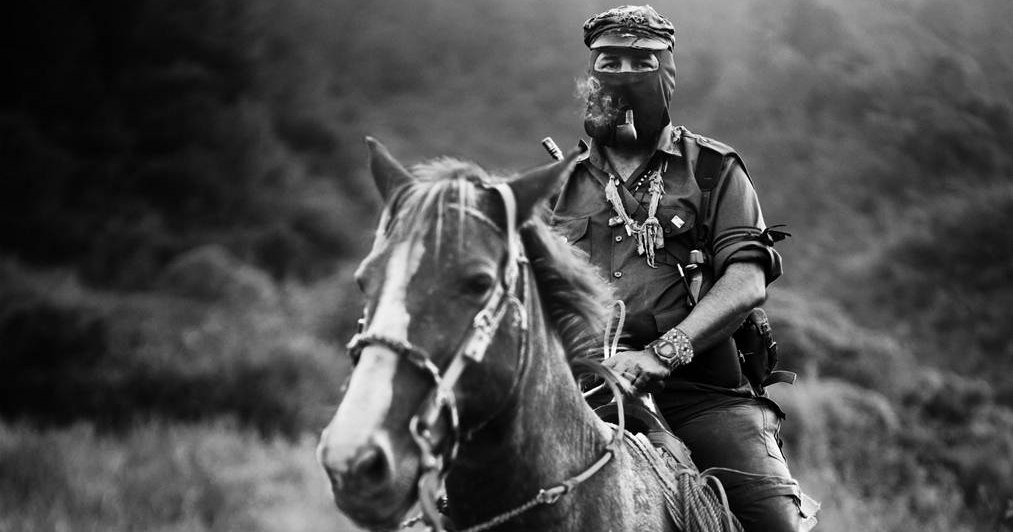
January 1st, 1994, was projected to be celebrated internationally as a day of rebirth and renewal. Besides marking the beginning of a new year, January 1st, 1994, also ushered in a new era of North American economic policy, being the day the North American Free Trade Agreement (NAFTA) would take effect.
Following years of negotiation, the agreement created the then-largest free trade zone in the world, removing virtually all barriers to trade between Canada, the United States, and Mexico. Politicians, multinational corporations, and foreign investors in North America alike celebrated the deal and looked optimistically towards the future.
Yet, on this day of mostly upper-class celebration, those at the bottom of North American societal hierarchies viewed NAFTA as a threat to their humanity. To this end, we can look at the ideologies of the Zapatistas, a grassroots indigenous rights group based in Chiapas, Mexico. The Zapatistas believed NAFTA was an extension of neoliberalism that compromised the interests of Mexico’s indigenous populations for the sake of industrial development.
Particularly, the Zapatistas condemned NAFTA forcing Mexico to amend its constitution to remove protections of communal lands (ejidos) in favor of private ownership in a process similar to the US’s Dawes Act. Beyond that, the Zapatistas believed Mexico’s projected increase in trade with the United States and Canada would significantly harm small-scale indigenous farmers.
On the first day NAFTA was set to be imposed over Mexico, thousands of Zapatista insurgents armed themselves and took control of seven Mexican cities over the course of just about a week. After successfully conquering each city, the Zapatistas broadcasted the First Declaration of Lacandon Jungle explaining both their struggle and plan to eventually conquer Mexico’s capital and depose the president.
Naturally, Mexico’s government didn’t take too kindly to the Zapatistas and instructed their forces to have “no compassion” in wiping out their forces. In just days, Mexico’s military pushed the Zapatistas far into the jungle of Chiapas and began censoring Zapatista news, using intense rhetoric to brand the group as being made up of illegitimate terrorists, strategies proven to be effective in silencing most rebel groups.
Despite the Zapatistas’ explicit aggression and Mexico’s rhetorical tactics, the movement, oddly, garnered significant public support. Thousands of Mexicans, both from and outside Chiapas, hosted public demonstrations condemning their government’s war against the Zapatistas and demanding a diplomatic solution. On January 12th, the public’s efforts paid off. The Mexican government was forced to declare a ceasefire and promptly invited the Zapatistas to negotiations in Mexico City.
The Zapatistas’ success in rallying the general public to support their cause stands out as almost unheard of among fellow militant movements from Latin America. For example, we can compare the Zapatistas’ triumph to the more typical failures of Sendero Luminoso, a Peruvian group that attempted to sprout a violent communist revolution in their country. Sendero Luminoso, on paper, resembled the Zapatistas; both groups are grassroots organizations looking to oppose neoliberalism through the armed takeovers of their respective countries.
Yet, while the Zapatistas were embraced by the public and offered negotiations by Mexico, Sendero Luminoso was loathed across Peru, and its leader was assassinated by the government just two years before the Zapatista uprising. While the Zapatistas continue operations today, retaining communal ownership over their lands, Sendero Luminoso, like most Latin American militant groups, remains fragmented due to government crackdown.
The Zapatistas were somehow able to break away from their predecessors’ patterns of failure. To most pragmatically resist the Mexican government and further their movement, the Zapatistas employed a wide variety of unique methods to retain public support, often coming at the cost of their own ideals.
First, and most obviously to scholars, the Zapatistas differed from their contemporaries in that they were a relatively peaceful armed militant group. The group had one clear enemy, the Mexican government, but avoided targeting civilians even in the municipalities they conquered. While the Mexican government took hundreds of Zapatista hostages, the Zapatistas took just one hostage: the corrupt former mayor of Chiapas. Since most deaths were caused by Mexican federal forces, it was easy for the public to want to side with the noble indigenous group in opposing Mexico’s corrupt government.
These military strategies notably differ from those of groups like Sendero Luminoso, which emphasized targeting civilians and inciting terror instead of appealing to the public’s desire for peace.
But, beyond traditional non-violence, I would argue that the Zapatistas took a new approach to civilian appeal by strategically diluting their cause to make themselves appear more agreeable. In other words, the Zapatistas dumbed down their movement to gain public sympathy.
Make no mistake, the Zapatistas’ cause is radically controversial. After all, the Zapatista uprising was a direct response to the imposition of NAFTA over Mexico. At the heart of the movement is an opposition to neoliberalism, a rejection of globalization, and a defense of communal systems of governance, all of which are generally unpopular ideals.
Thus, instead of highlighting their aforementioned beliefs, the First Declaration of the Lacandon Jungle urges civilians to “support this plan that struggles for work, land, housing, food, health care, education, independence, freedom, democracy, justice and peace.” The Zapatistas rebranded their uprising from being about tearing down globalization to being about upholding human rights, which the international community was happy to support.
Lastly, outside Mexico, the Zapatistas garnered popular support by respecting international law and appealing to several NGOs. Though the Zapatistas were ideologically against globalization, they found themselves forced to rely on its very drivers to sustain their legitimacy.
For instance, the Zapatistas pledged to follow the Geneva Conventions in their warfare and promised to turn all wounded Zapatistas and civilians over to the International Red Cross. All in all, by following international standards, the Zapatistas tethered their local cause into systems larger than themselves and boosted their movement’s legitimacy.
Since the initial 1994 uprising, the Zapatistas have secured their right to self-governance, rejecting Mexican politics and creating effective semi-autonomous zones in Chiapas. While it’s a shame that the Zapatistas arguably had to give up the purest form of their movement to gain international approval, it was ultimately a sacrifice that had to be made. The Zapatistas’ strategic concessions were the only barrier preventing the movement from being completely destroyed by Mexican authorities.
Latin-American leftists movements, whether militant or non-violent, have a history of being crushed before they can begin, largely because the struggles of the lower class are often villainized or ignored by the general public. Even when radical candidates are democratically elected, like President Salvador Allende of Chile was in 1973, they’re often silently decimated by state violence before they can make a tangible impact.
Even modern militant groups like Colombia’s National Liberation Army are limited in scope, because though they share Zapatista ideologies, fail because of their violent, small-scale methodologies. The Zapatista’s strategies of both drawing attention to themselves to avoid being silenced while remaining relatively peaceful to build sympathy for their cause should forever be remembered and followed as a masterclass in effective resistance.
Leftist movements seeking to prioritize pragmatism over ideology ought to emulate the Zapatistas’ strategies of public appeal to most effectively resist systems of oppression on a large scale.

 Spykman Institute
Leave a comment