
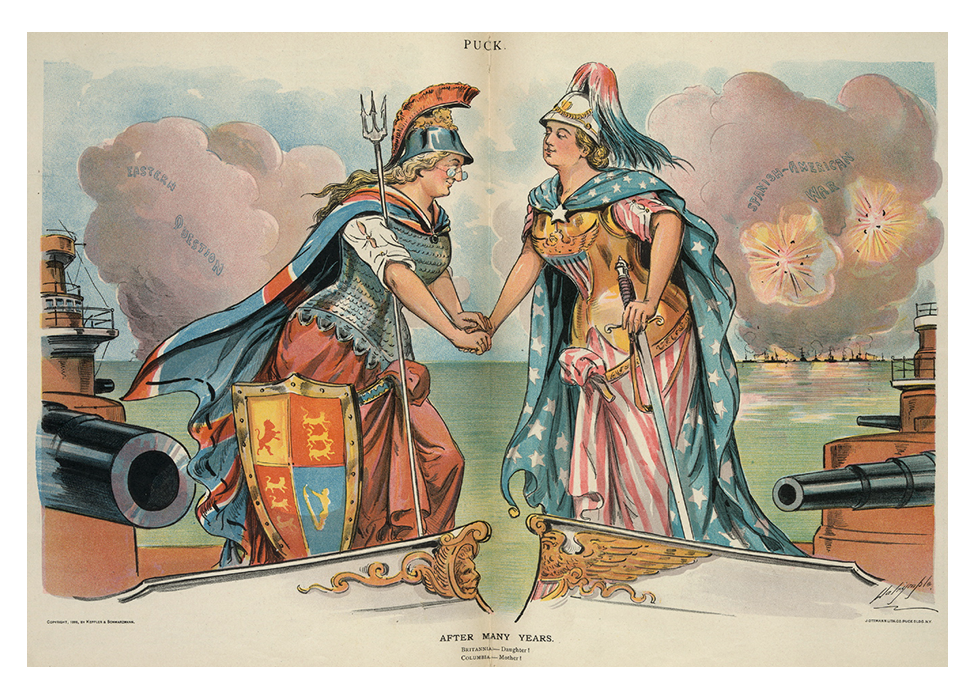
In international relations, hegemony is political, economic, or cultural dominance that one nation or region has over others. A hegemon’s actions often impact other nations’ decisions and cultures.
Hegemony can be formed through the exertion of hard power (like military occupation, imperialism, and war) or soft power (like political alliances, advances in technology, and the diffusion of culture).
Some international relations experts argue hegemony is essential to geopolitical stability. For example, the hegemonic stability theory, developed by Robert Gilpin and Stephen D. Krasner, posits that hegemons keep other countries in check and provide global infrastructure, political capital, and military power that other nations cannot.
However, critics of hegemony argue that the dominance of certain nations creates inequality and destroys minority cultures. Scholars like J. David Singer and Karl Deutsch argued in favor of multipolarity, where power is more decentralized and multiple nations share global influence.
Examples of hegemony include:
- The United States’ current global military influence and power to shape institutions like NATO and the United Nations
- The USSR’s political and economic capital in the 20th century leading Eastern Europe to effectively model itself after the country
- Great Britain in the 18th and 19th centuries culturally, militarily, and economically controlling a fifth of the world’s population through imperialism
Hegemony lays the foundation for how we think about geopolitics. Always be on the lookout for its influences!


 Spykman Institute
Leave a comment