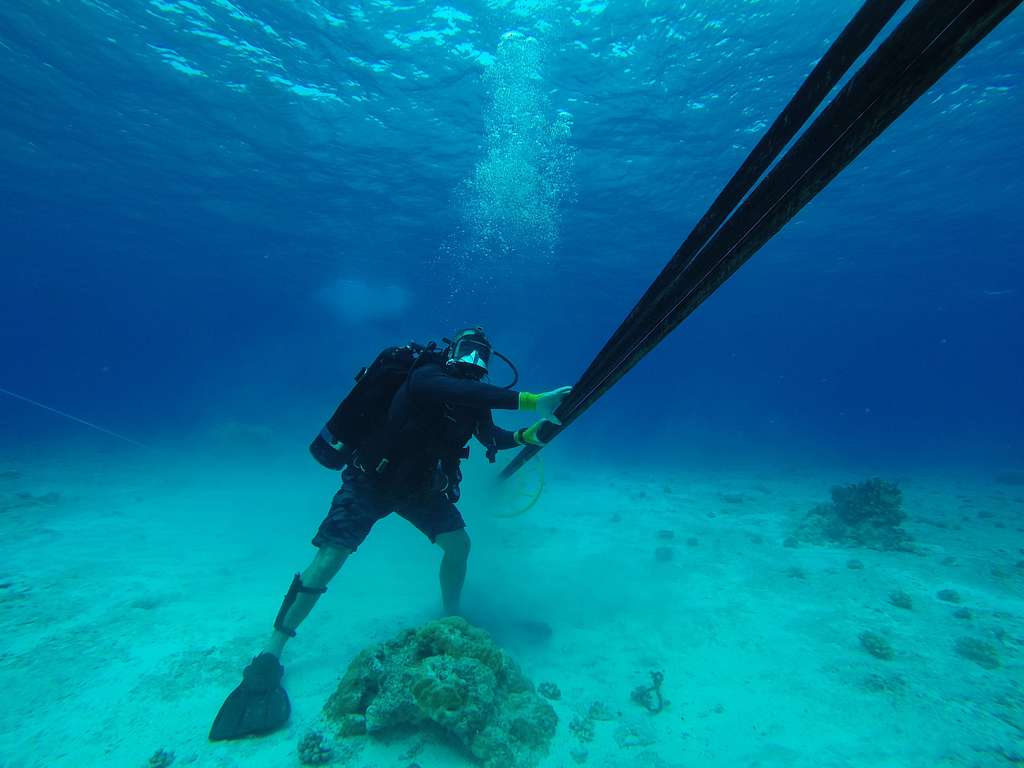
When most people think of the cloud economy or cloud technology, they think of a vast, shapeless, and borderless digital realm. This perception of the cloud is a myth. Over 95% of all transcontinental data is transferred through a physical network of undersea fiber-optic cables resting on the dark ocean floor. This includes military commands, financial transactions, and simple internet traffic.
In short, the entire international economy relies on this network of underwater cables, each barely the size of a garden hose, with one broken every three days. Yet the network is so vast that it can support an increasingly virtual society and supplement the myth of the cloud. This system is as intricate as it is fragile, and it may be time for our increasingly vulnerable world to move towards satellite technology. If it does not, disaster may strike, not because of a missile launch, but because of a severed cord.
In the 1970s and 1980s, computer scientists and telecom engineers drew countless diagrams to map out a variety of networks. In their schematics, scientists drew simple cloud symbols to represent the point where data entered localized internet servers. The “cloud” was born simply as a label for a local data center. However, in the late 1990s and early 2000s, tech giants realized that the cloud could be used as a metaphor for the vastness of technological innovation and convinced businesses, politicians, and the public that data exists in a magical, untouchable ether.
Behind the seamless interface of the modern internet lies a staggering feat of high-voltage submarine engineering. Today’s global network relies on fiber-optic cables. At the center of each garden-hose-sized cable are tiny strands of silica glass. Instead of sending electrical signals like old phone lines, fiber-optic cables send data through lasers. Because light naturally degrades over long distances, cables use heavy repeaters every 40 to 50 miles to amplify their signals using around 20,000 volts of electricity.
Because of the high cost of laying and operating thousands of miles of cables and repeaters, high-level companies frequently use the same pathways. This forces dozens of separate cables to bundle together through narrow, shallow straits. If a cable ever snaps, the power line through it goes down, creating a disruption.
However, repairing submarine cables is a relatively common and fixable issue. “Cable-laying ships” manually drop hooks to grab broken cables and splice the glass fibers back together. However, this simple process can quickly become difficult because of its limited availability. Cable-laying ships remain rare amongst naval fleets, and their repairs can be timely and costly. Beyond that, damaged repeaters or geographic disasters can cause more harm than cable-laying ships can repair, potentially disrupting power lines and blinding entire regions.
The physical constraints of Pacific geography have created key chokepoints in the world’s fiber-optic cable networks. Just as international trade is dictated by the vitality of key straits, the digital economy is as well. By funneling the world’s virtual wealth through the same narrow gates, modern technology is mapped onto the same geographic chokepoints that have existed for centuries.
Fiber-optic cables’ physical concentration has created an environment ripe for espionage. An opponent can weaken a nation without declaring overt war by exploiting the unlegislated nature of the cables they use to communicate. This could be seen in late 2024, when the Chinese ship Yi Peng 3 dragged its anchor for over 100 miles, slicing critical communication cables between Sweden, Finland, and Germany.
After that incident, in early 2025, vital cables connecting Taiwan to bordering Matsu and Penghu islands were suspiciously disrupted, causing widespread technological disruption. These incidents are practically unpreventable because maritime law makes it difficult to prosecute foreign shifts for accidents in international waters. It is nearly impossible to gauge the intention behind an enemy breaking a cable. The submarine yet exposed nature of fiber-optic cable networks puts the technological economy at risk of disaster.
To prevent worries surrounding fiber-optic cable networks from increasing, a resilient and hybrid failsafe is necessary. This is the driving logic behind NATO’s recently launched Project HEIST (Hybrid Space/Submarine Architecture Ensuring Infosec of Telecommunications). The first aspect of Project HEIST is fault diagnosis. In other words, the project advocates for creating infrastructure to quickly pinpoint subsea cable breaks so they can be promptly and efficiently addressed.
The next aspect is ambitious space rerouting, which aims to combine global fiber-optic systems with high-speed satellites, hopefully creating the infinite “clouds” that are commonly believed to exist. While costly and slightly less efficient than the underwater networks that currently exist, a satellite system will ensure data is not lost when undersea cables are compromised. Project HEIST provides a clear example for how nations can fortify their technology.
The Indo-Pacific is the center of the global digital economy, even despite its geographic vulnerabilities. To secure the Luzon and Malacca Straits’ stability would be paramount for Pacific powers. Only by anchoring terrestrial networks to a space-based failsafe can Pacific nations finally turn the myth of a secure, untouchable “cloud” into a resilient reality.


 Spykman Institute
Leave a comment