
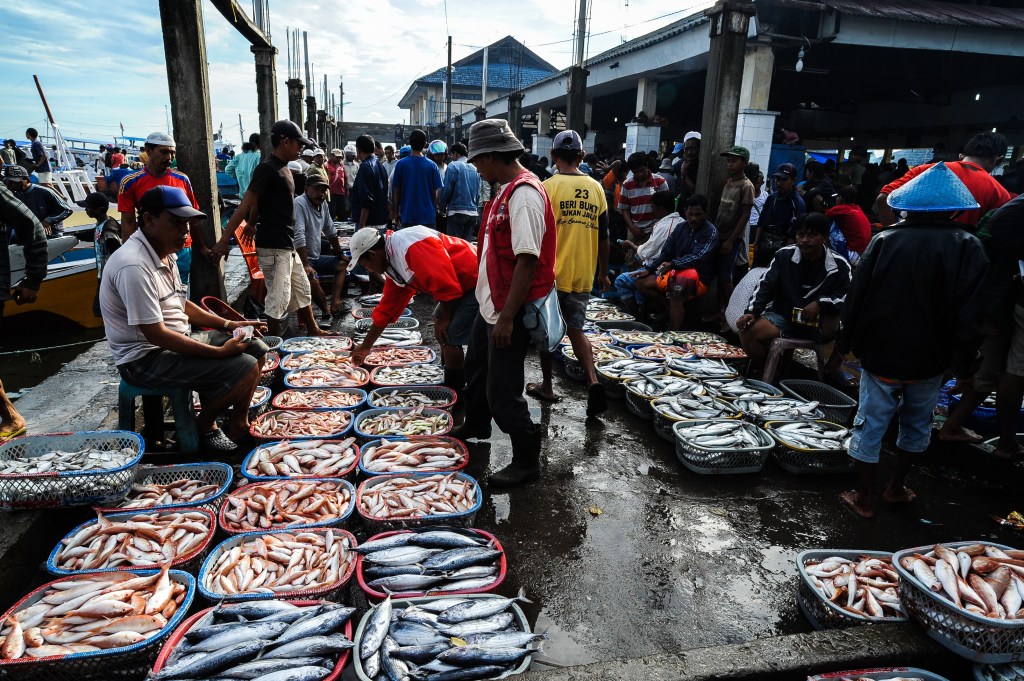
As climate change warms the world’s waters, fish habitats are being severely affected. Oxygen levels in water are dropping, and fish are becoming smaller and less numerous. However, rises in water temperatures affect not only fish but also the people who hunt them. As fish populations dwindle due to climate change and demand increases, fishing becomes more contentious in popular seas. Overlapping claims on fishing zones have the potential to erode existing global fishing frameworks in favor of global superpowers.
Biodiversity and fish populations in Southeast Asia have long been declining because of a combination of factors. According to Stanford Economic Review, from the mid-1990s to 2007, oceans around the globe absorbed 30 billion metric tons of carbon dioxide. Absorbed carbon dioxide not only increases ocean temperatures but also reduces the ocean’s oxygen content. In areas like Southeast Asia where economies rely on fishing, this phenomenon is detrimental as it affects both the distribution and abundance of fish in the region.
Fishing in Southeast Asia is non-negotiable. The Center for Strategic and International Studies (CSIS) states that fish accounts for about 60% of the protein consumed in Southeast Asia. Additionally, 30 million people, or 1.4% of the Southeast Asian population, work in fisheries, according to the Stanford Economic Review. Changes in fish populations and behavioral patterns would force widespread diet changes and fundamentally shift all Southeast Asian economies. A declining Southeast Asian fishing industry will increase unemployment and diminish the region’s quality of life.
The issue of overfishing only adds to Southeast Asia’s aforementioned problems. Since the 1950s, the CSIS estimates that 70-95% of Southeast Asian fish stocks have been depleted or are at risk of collapse. However, with Southeast Asian economies being heavily reliant on fisheries, overfishing will likely persist as countries turn a blind eye to the problem. The lack of government oversight regarding overfishing is exemplified by the prominence of Illegal, Unreported, and Unregulated (IUU) fishing.
According to the Korea Institute for Maritime Strategy, ASEAN countries incurred a $6 billion loss due to IUU fishing. IUU fishing threatens environmental sustainability and conservation efforts by local governments. The lack of regulation and the inability to tally fish caught by IUU fishers makes it impossible for governments to create practical legislation regulating fisheries.
The lack of authority from sovereign governments in Southeast Asia, coupled with changing fish patterns, creates a vulnerability, exposing fishing industries to control from global superpowers. As the ecosystems of local fishing zones and Exclusive Economic Zones (EEZs) become less abundant, fisheries venture farther out into contested waters like the South China Sea.
The primary issue with fishing in the South China Sea is the overlapping claims that different countries have over the waters. China and Southeast Asian countries compete for their various claims and develop their military in an effort to protect them. Historically, China has built several man-made islands with military infrastructure with the sole purpose of protecting its claims in the South China Sea. This signals Beijing’s unwillingness to make substantive territorial concessions, as it opts instead to protect its claims with its military power.
Beyond competition with China, there are conflicts within Southeast Asia as well. Cambodia and Thailand, according to the Korea Institute for Maritime Strategy, are competing for a maritime area of 27,000 square kilometers. Fishing industries in Southeast Asia will take a heavy toll if conflicts endure. However, with the slow progress of deliberations over the countries’ overlapping claims, governments are simply deciding to militarily patrol each zone. While fighting within Southeast Asia, it becomes difficult for countries to challenge China because they are engaged in conflicts on multiple fronts.
Rather than creating legislation or negotiating with other countries, both China and Southeast Asia resort to gray zone tactics and subsidies. According to the Stimson Institute, governments in Southeast Asia spend $20 billion on fishery subsidies each year. China allocates 96% of its fishery subsidies to industrial fleets. With such investment, both regions use excess subsidies to occupy contested waters with fishing vessels escorted by the navy. Furthermore, independent maritime militias have proliferated, with many fishers hiring private protection for their operations. This adds to the militaristic nature of fishing in Southeast Asia, only escalating both tensions and the likelihood of a prominent conflict in an already combative region.
Even with rising tensions between Southeast Asia and China, the fishing industry has also passed the point of no return. According to NPR, even if the world were to limit global warming to 1.5°C (2.7°F) and halve its fishing intensity, the South China Sea would still lose more than a fifth of its fish population. Oceans continue to grow more acidic as they absorb more carbon from greenhouse gas emissions. Overfishing and countries’ lack of regulation will continue, further damaging fish populations and local ecosystems. The future of fishing industries will be detrimental to Southeast Asian countries, and there doesn’t seem to be a clear-cut solution to prevent fishing’s decline.
Looking beyond Southeast Asia, conflicts and environmental changes will cause global changes. According to the Southeast Asian Fisheries Development Center, Southeast Asia produces roughly 18.6 to 18.8 million metric tons of marine catch annually. This makes up about one-fifth of the world’s total capture. With substantiated declines in the fishing industry, countries around the globe will have to develop new frameworks to accommodate the decrease in seafood from Southeast Asia or become more involved in local politics to ease tensions in the South China Sea.
As tensions escalate militarily and governments stagnate, the question becomes to what extent the conflict will occur, rather than how countries can prevent it. Just as Southeast Asia has passed the point of no return environmentally, it seems the region has also passed the point of no return diplomatically.

 Spykman Institute
Leave a comment