
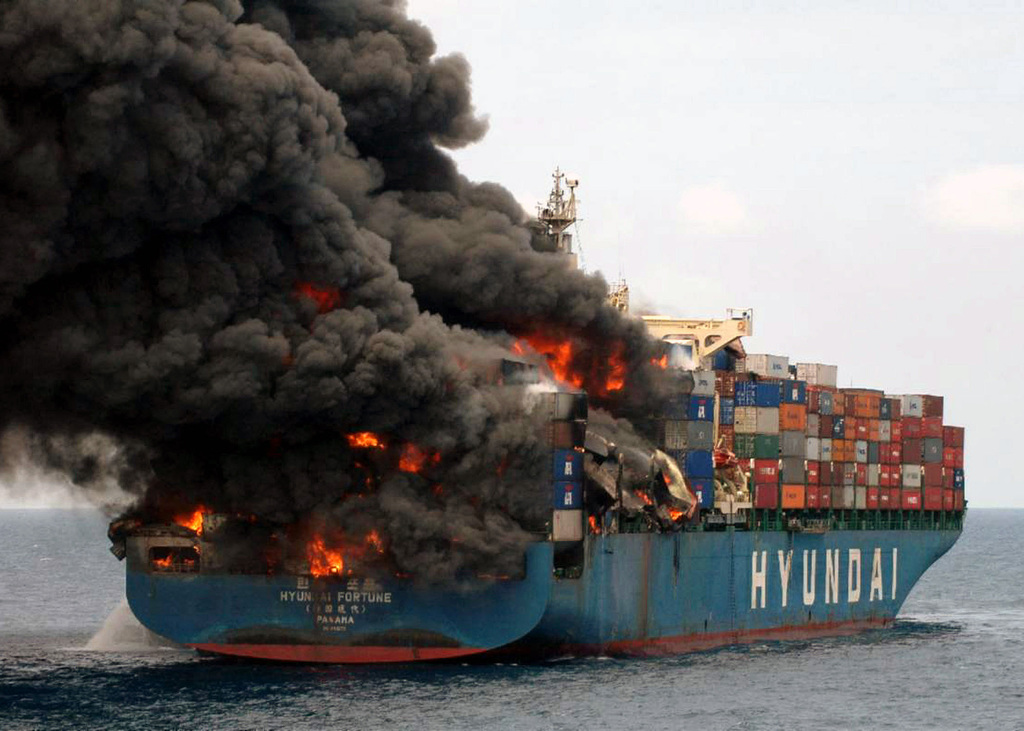
Pacific trade has largely avoided the political instability and economic volatility that other networks, such as Middle Eastern trade, have seen in recent history. Despite historical tensions between major powers, including China and the US, more than half of maritime trade goes through the Pacific. Pacific trade is seen as stable. While military conflict may not pose a large threat to this stability, the financial systems that react to it might.
Trade through the Pacific is largely dominated by two straits: the Strait of Malacca and the Taiwan Strait. Situated between Malaysia, Singapore, and Indonesia, the Strait of Malacca is the main shipping lane between the Indian and Pacific Oceans. According to data from the Center for Strategic and International Studies, the Strait of Malacca carries around one-quarter of global maritime trade and one-third of global seaborne oil trade, making it the world’s busiest trade route. Meanwhile, the Taiwan Strait facilitates around one-fifth of maritime trade, moving over $2.4 trillion of goods each year.
Both of these straits are vital to Chinese trade. In 2024, one-third of China’s imports passed through the Taiwan Strait, and one-fifth passed through the Strait of Malacca. Chinese officials have long rued the Malacca Dilemma: the fact that China is overreliant on a strait not directly monitored by Chinese authorities. Despite actions to reduce Chinese overreliance on the Strait of Malacca, over three-quarters of China’s oil imports come through the channel. Beyond Malacca, China is also strategically vulnerable because it lacks direct control of the Taiwan Strait. As China and Taiwan’s relationship remains fractured, the strait stands as another pressure point in Pacific trade.
The crisis at the Strait of Hormuz in the Middle East earlier this year showed that regional instability has the potential to reach into the international economy, even absent direct military intervention. Iran shut down the Strait of Hormuz in February of 2026, sparking an energy crisis due to the strait’s centrality in trans-continental trade. While a similar shutdown in the Pacific is unlikely in the immediate future, the Hormuz crisis reveals the power of a hidden threat: insurance companies’ response.
Within 48 hours of American airstrikes on Iran on February 28, 2026, war risk premiums had multiplied fivefold. According to Dr. John Hatzadony, insurance quickly became a “weapon system” indirectly aiding Iran’s military efforts to immediately close the Strait of Hormuz. Traders’ possession of insurance is not optional; tools like war risk premiums are fundamentally baked into maritime trade and have an undeniable effect on the use of maritime trade routes.
A trade ship must hold three key components of maritime insurance: hull and machinery coverage, protection and indemnity coverage, and a war risk premium. The war risk premium is especially vital because it is the most affected by political instability, making it the most volatile component of maritime insurance. In the case of Iran, insurance companies’ response was a key catalyst for the closure of the Strait of Hormuz.
Outside of Hormuz, an independent body, the Lloyd’s Joint War Committee, has long dictated both the perceived risk for insurers in maritime trade and the timing of insurance price escalation. When the committee designates an area as being high risk, insurance costs immediately rise, and commercial shipping becomes far more expensive. This very situation occurred in the Middle East just days after 2026’s first strikes. If the Pacific found itself in a similar situation following military conflict, it could represent a major threat to the region’s trade stability.
Dr. Hatzadony remarks that the most powerful aspect of maritime insurance is that it creates a cycle in which a crisis compounds itself. An insurance interdiction requires fewer resources than sustaining a military effort. Moreover, insurance companies act in their own self-interest and are incentivized to continuously raise premium prices to be as high as possible. Because of this, a single geopolitical conflict can trigger an automatic, self-reinforcing cycle of rising insurance costs and simultaneously declining trade.
Both the Strait of Malacca and the Taiwan Strait are far from oases of stability. The Taiwan Strait has long been deemed a “grey-zone” region, existing between war and peace. The Strait of Malacca is similarly vulnerable, with frequent piracy and other security threats plaguing ships. In the past, these issues were seen as isolated regional disputes that would not affect the greater international economy. Today, however, insurers hold the power and leverage to transform even localized tensions into disruption across vast trade routes.
An insurance crisis through the Strait of Malacca and the Taiwan Strait would not only impact the nations surrounding the crisis but also the entire international trade community. Nations would likely decrease trade through affected straits and, in turn, pursue other routes or shift production elsewhere. The result would be a more costly and less efficient Pacific trade network.
The threat of insurance spikes within the Pacific should not be a catalyst for international panic, but rather, a reminder of the importance of cooperation between nations, regardless of localized disputes. Insurance companies have repeatedly shown that financial markets can react faster than governments or militaries.
Thus, as long as Pacific nations can control regional conflicts, Pacific trade will remain stable and efficient. Ultimately, the future stability of the international economy cannot be guaranteed by the mere prevention of full-on war. It also depends on preventing geopolitical tensions from triggering insurance markets that can shut down trade long before a navy ever can.

 Spykman Institute
Leave a comment