On February 28th, the United States and Israel launched strikes on Iran. Within days, commercial shipping through the world’s most critical oil chokepoint had collapsed, causing traffic to drop by more than 90 percent. The Strait of Hormuz has been effectively closed for most of 2026. About one-fifth of the world’s oil consumption is fueled by exports through the strait.
However, following this year’s conflict, the world’s four largest container shipping conglomerates (Maersk, MSC, CMA CGM, and Hapag-Lloyd) suspended transits through the chokepoint according to logistics firm Carra Globe, leaving more than 1,500 ships stranded. Brent crude (a global oil benchmark) has climbed toward $100 a barrel with no sign of slowing down, even as vessels attempt to pass undetected through the Strait of Hormuz. Lloyd’s List Intelligence has reported that no large vessels have traveled through the chokepoint with their tracking systems on since July 7th.
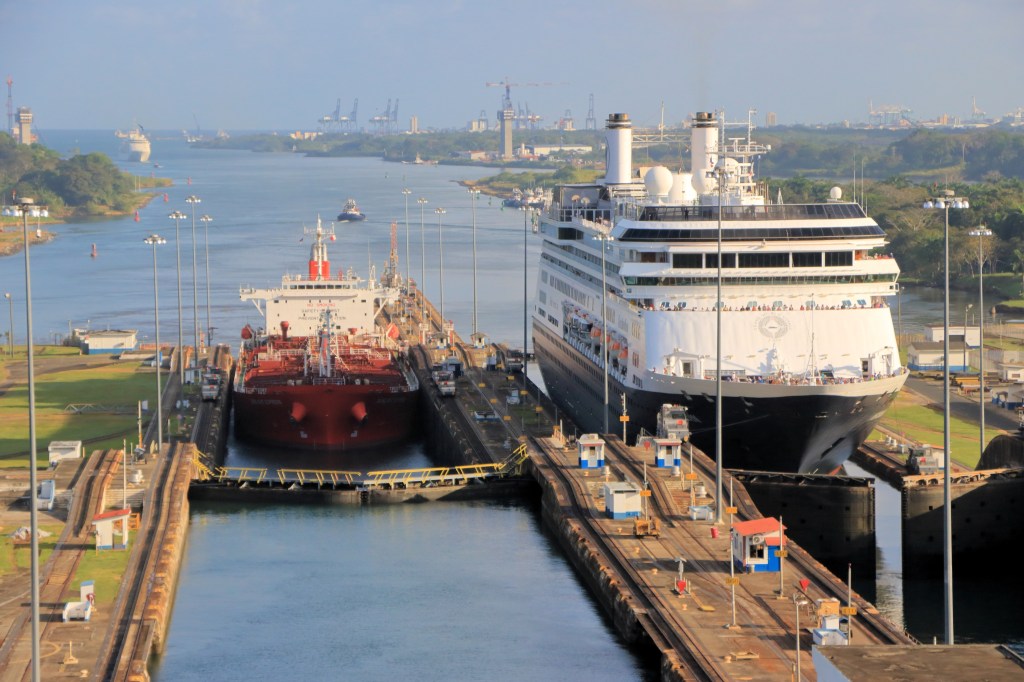
However, while headlines and news outlets cover the Hormuz crisis, 8,000 miles away, the Panama Canal faces a similar crisis with the same root cause and possibly similar outcomes.
The Panama Canal handles roughly 40 percent of all U.S. container traffic and moves an estimated $270 billion in cargo annually, according to the Panama Canal Authority. Earlier this year, Panama’s Supreme Court ruled that the laws upholding concessions held by CK Hutchison, a Hong Kong-based conglomerate, to operate two port facilities at either end of the Panama Canal were unconstitutional.
China’s government responded without respite. Beijing warned Panama that the country would “inevitably pay a heavy political and economic price,” according to CNBC. Chinese authorities directed state firms to halt talks on new projects in Panama. Meanwhile, the U.S. Federal Maritime Commission noted a surge in detentions of Panama-flagged vessels by Chinese authorities that “far exceed[ed] historical norms.”
The Hormuz crisis shows what could happen when a vital chokepoint is clogged. Following this year’s conflict, shipping companies were forced to reroute around the Strait of Hormuz, making each voyage take weeks longer and cost thousands of dollars more. War-risk insurance premiums for vessels increased to as much as 0.4 percent of ship value per crossing, according to CBS.
European energy buyers, desperate to replace disrupted Gulf supplies, turned to Russian Arctic LNG (Liquefied natural gas) instead. The European Union imported a record volume of Siberian LNG between January and April 2026, according to data reported by The Independent. For governments that have spent the last several years trying to reduce their dependence on Russian energy, this change represents a massive political rerouting.
The Panama Canal is facing none of this, at least not yet. But as America’s Quarterly argued, Panama is facing the same vulnerability in different ways. The country wields control over a vital component of global trade infrastructure, but is not fully equipped to manage the competition in and around it. Panama’s foreign policy toward the canal has been “largely improvised” for decades, and the country has no formal criteria for evaluating infrastructure concessions and no official neutrality commitments.
These circumstances culminated in the aforementioned exploitative deal with CK Hutchinson that remained a vulnerability in the small nation for years. When Panama’s Supreme Court finally struck it down, the ruling became a point of conflict, forcing a country of four million people to suffer through the crossfire of the trade war between Washington and Beijing.
To prevent the exploitation of chokepoints such as the Hormuz strait and Panama Canal and preserve the flow of international trade, major powers must shift their mindset. Instead of competing over chokepoints vital to trade, they should treat them as public infrastructure that benefits all parties and consciously choose to protect them.
Right now, the United States is pressuring Panama to expel Chinese port operators, Iran is using the Strait of Hormuz as a weapon, and China is retaliating against Panama-flagged ships in Chinese ports. Clear enforcement mechanisms are necessary for international frameworks for freedom of navigation, which, as of now, only exist on paper.
But, beyond that, Panama specifically needs to develop a formal strategic doctrine for the canal. Panama cannot stop Washington and Beijing from competing, but it can stop the canal itself from being caught in that dangerous competition.
The Panama Canal is not on fire today; the Strait of Hormuz is. And the world’s response to the Hormuz crisis, scrambling, expensive, and improvised, should be all the evidence anyone needs that waiting for a crisis to take trade infrastructure seriously is no more of a policy than a haphazard guess. It’s a bet the world has lost once, and should be careful of not losing again.
 Spykman Institute
Leave a comment