
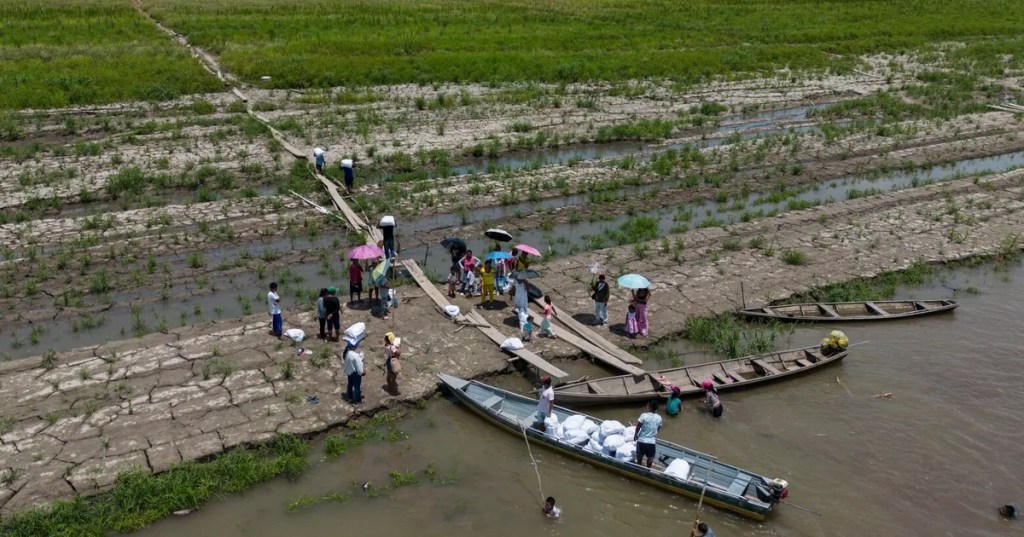
Yesterday, Oxfam released a report, covered by Reuters, that should have led every American news broadcast. El Niño is driving a severe food crisis across Central America’s Dry Corridor. Across 58 municipalities in Guatemala, Honduras, and El Salvador, roughly 91,000 rural households were affected. More than 70,000 corn-farming households reported catastrophic crop losses. The people now struggling to stay on their feet are not refugees fleeing violence or political persecution, but subsistence farmers whose fields can’t produce.
People do not generally pack up and leave because temperatures rise. As droughts reduce crop yields and eventually cause failed harvests, they eliminate income. Families borrow to survive, and debt accumulates faster than it can be paid off. After enough cycles, staying becomes more dangerous than leaving.
With so many people moving, the question is whether they move to a city in Honduras, to Mexico City, or to the US-Mexico border. Climate migration is not an immigration problem and will not be solved by border policy. It is an agricultural problem with an immigration consequence that will be answered by agricultural policy, water infrastructure, and rural investment, none of which the United States is currently treating as immigration tools.
A University of Pennsylvania study published in April 2026, using an AI system trained on 25 million Central American news articles, mapped exactly the process of climate immigration. The researchers found that climate shocks do not produce sudden waves of movement. They produce slow economic erosion that eventually tips a household toward departure.
A survey found that 1 in 12 families in the Dry Corridor already reported planning to migrate due to prolonged drought. That was before the current El Niño cycle. Over the past 30 years, drought losses in the Dry Corridor approached $10 billion, according to the World Bank and Migration Policy Institute, half of which fell directly on the agricultural sector. It is estimated that 30 million Central Americans could move toward the US-Mexico border over the next 30 years if current trajectories continue.
The US government’s current response to this is to spend more on border enforcement.
That response is not irrational, but it’s solving the wrong problem. Enforcement addresses migration after it happens, but the conditions that make migration necessary in the first place can be addressed instead. The Carnegie Endowment for International Peace published an analysis in June 2026 making an interesting connection: Remittances from migrants in the United States already function as the largest climate adaptation fund in Central America, whether anyone calls them that or not. Remittances averaged 12.7 percent of GDP across Central America between 2014 and 2024, reaching 27.3 percent of GDP in Honduras. When a Farmer’s crop fails and a family member sends money home, it keeps the household from migrating. Immigration enforcement that drives down remittances by reducing the migrant workforce in the US does not keep Central Americans home and instead does the opposite.
The region is not completely unequipped, though. A Water Smart Agriculture program across the Dry Corridor that supplies farmers with real-time soil quality data and climate-adjusted planting guidance by Catholic Relief Services has been highlighted as a model worth scaling by the United States Institute of Peace. Drought-resistant seed varieties, improved early warning systems, and irrigation investment have all demonstrated measurable reductions in crop failure rates in pilot areas. Although these programs exist, they are not funded at all as much as the crisis demands.
There is the optimistic case with Central America’s genuinely young population. The same demographic window that makes the region’s workforce attractive for nearshoring (as covered in a previous piece) also means that well-supported communities have decades of productive economic potential ahead of them. A 25-year-old farmer who switches to drought-resistant crops and is able to earn a stable income does not need to migrate.
With agricultural investment costing a fraction of what enforcement spending does, regional governments should act.
The United States, Mexico, and Central American governments should pool funding for the Dry Corridor, treating it as shared infrastructure. Drought-resistant agriculture programs like the CRS Water Smart model should be funded at national scale rather than as aid pilots. Governments can expand seasonal migration pathways for agricultural workers, reducing circular migration, where workers move temporarily and return, keeping remittances flowing healthily.
None of this should require the US and other countries to necessarily abandon border enforcement or ignore asylum law, but addressing the cause of migration might be able to prevent it more than enforcement could.


 Spykman Institute
Leave a comment