
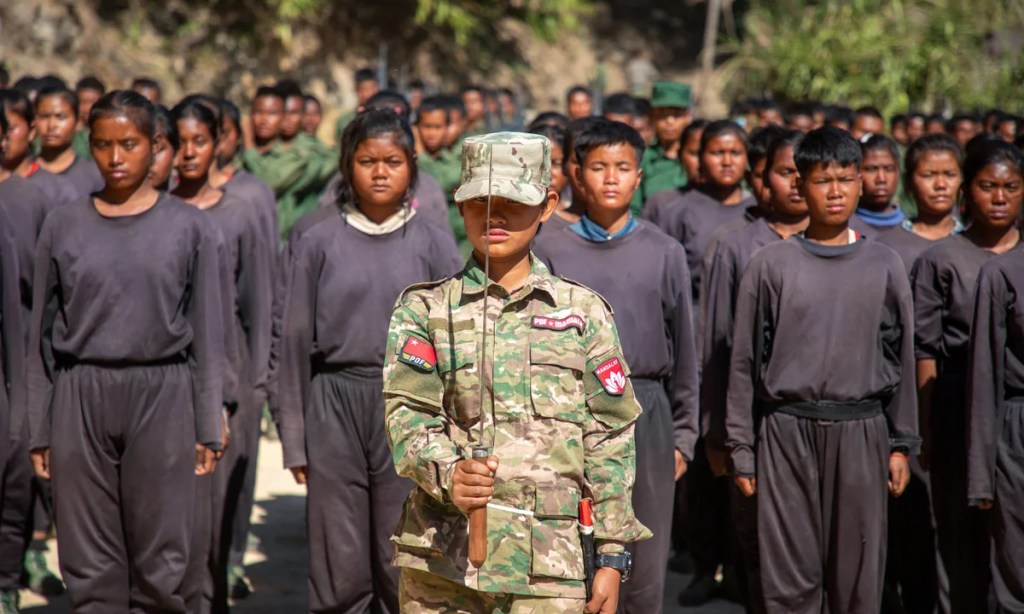
On February 1st, 2021, Myanmar succumbed to a military coup, starting the Myanmar Civil War. The state military, known as the Tatmadaw, seized power, claiming that previous elections were fraudulent and illegitimate. Anyone opposing the coup was arrested and thrown into prison, including the previous leader of Myanmar, Aung San Suu Kyi. Following the coup, military general Min Aung Hlaing took rule of the country, significantly altering political systems and Myanmar culture. Following 5 years of conflict, according to the Organization for World Peace (OWP), 100,000 people were killed and 3 million were displaced. With such a significant conflict, many individuals are in disarray, seeking refuge in neighboring countries. As much as governments in neighboring countries may want to help refugees, the massive influx of refugees from Myanmar creates unsustainable spending, decreasing the quality of society in such countries.
Conflict persists in 2026, with an estimate from OWP tracking that 450 civilians have been killed in the first half of 2026. Yet, the conflict has not gone unnoticed by the global community. Countries in the European Union, Canada, the United Kingdom, and the United States have all placed sanctions on anything associated with the Tatmadaw. Sanctions from the United States restrict the export of goods from Myanmar and freeze the assets of the government in Myanmar held in the US. President Trump has also enforced a travel ban on Myanmar nationals. The UK followed suit, also freezing assets held by the Myanmar government in the UK. The UK also enforced its own travel ban for anyone associated with the Tatmadaw. EU restrictions are similar to both the US and UK, involving both the freezing of assets and a universal travel ban.
With global restrictions on Myanmar since the beginning of the conflict, countries in Southeast Asia are left to handle the massive outflux of individuals as the civil war lengthens and escalates to new extremes. The massive cross-border migrations strain humanitarian systems as they grapple to process and integrate the massive number of refugees entering their countries. According to Open Development Myanmar, there are about 1.35 million refugees from Myanmar located around the world.
With such a flood of refugees, Southeast Asian countries are bound to reap the consequences of a civil war. We can analyze the consequences with the case of Bangladesh in 2017. In August 2017, there was a military crackdown in Myanmar’s Rakhine State, which forced 700,000 Rohingya to flee into Bangladesh. The Rohingya are a Muslim ethnic minority that is denied citizenship in Myanmar, causing them to face many challenges trying to obtain their basic rights.
Currently, there are about one million Rohingya refugees in camps along the border of Bangladesh. These refugees face overcrowding; limited access to clean water, healthcare, and sanitation; high rates of malnutrition; and the constant risk of being exploited. Disease spreads quickly in these camps. According to the International Rescue Committee, there were 34,600 suspected cases of measles as of April 28th, 2026. The committee further explains that this resulted in 200 confirmed deaths. The actual number is likely much higher, as severe overcrowding and high population density make it difficult to track the true number of deaths.
The problem arises because these refugees lack the legal right to freely leave their camps or find work. This causes these refugees to rely purely on humanitarian aid for survival. Yet, the United States Department of State has terminated over 10,000 foreign aid grants, according to the International Rescue Committee. According to UN News, the UN launched an appeal for $710.5 million in humanitarian aid for Rohingya refugees; however, this figure is 26% lower than previous years despite the increase in the number of refugees and the increased need for aid. This signals that certain programs are getting cut, increasing the risk factors for these refugees. The refugee crisis not only creates an unsafe living environment in a neighboring country, but it also bottlenecks the country’s systems as individuals struggle to survive. With diminishing cooperation from international countries, countries are left to fend for themselves as they deal with such an influx of refugees.
The systems that exist in Southeast Asia are strained as they grapple with a continuous flow of refugees from Myanmar. According to Human Rights Watch, 4 million refugees are living in Thailand because of the conflict. Yet, these individuals are undocumented and are in constant threat of facing harassment, arrest, and deportation back to Myanmar. The internal conflict with these refugees is that their refugee status is recognized under international law but not by Thai law. Thus, individuals are under self-imposed house arrest, as Myanmar citizens have no legal access to healthcare, education, or work. Aligning with the situation in Bangladesh, this forces individuals to rely solely on humanitarian aid. Yet, the issue that arises is that such individuals are not recognized as individuals who qualify for aid, causing their lives to be stagnant as they hope for the end of the Myanmar Civil War.
Other Southeast Asian countries are in similar situations as they don’t recognize individuals fleeing from Myanmar. Therefore, other Southeast Asian countries, like Thailand, are not required to, and will not, give aid to such individuals, having them fend for themselves as they scavenge to start their lives over. Malaysia, Indonesia, and Thailand all treat Myanmar citizens as illegal, putting them at risk of getting deported back to the country they were fleeing from. According to the Diplomat, there are 90,000 refugees in Malaysia and 14,000 in Indonesia. Yet, the care for these refugees does not come from the countries but rather from the United Nations High Commissioner for Refugees (UNHCR). Yet, the systems of the UNHCR are inefficient and slow, with wait times extending for months, leaving many refugees in precarious situations as they avoid local police.
To add to the problem, the Trump administration has cut USAID funding, straining UNHCR even more. The Diplomat explains that 40% of UNHCR’s donations come from the US. In March 2025, UNHCR announced that it had to freeze $300 million worth of planned global activities. With continued cuts, the refugees are left in a hopeless situation in other countries. With no end in sight for the Myanmar civil war and without an officially recognized status from countries in Southeast Asia, these refugees are forced to fend for themselves, which only strains systems within these countries.
With such a strain on internal infrastructure within Southeast Asian countries, it only heightens racism and violence toward the marginalized groups entering their countries. Without proper governance from these countries, Southeast Asia becomes a boiling pot for hate, creating negative attitudes toward each other and indirectly spreading the Myanmar Civil War to the rest of the region.
 Spykman Institute
Leave a comment